
Compliance for the automotive stack.
Type approval, ISA validation, and the GDPR records and transfer documentation for test fleets and connected vehicle data. The agents draft; your team approves.
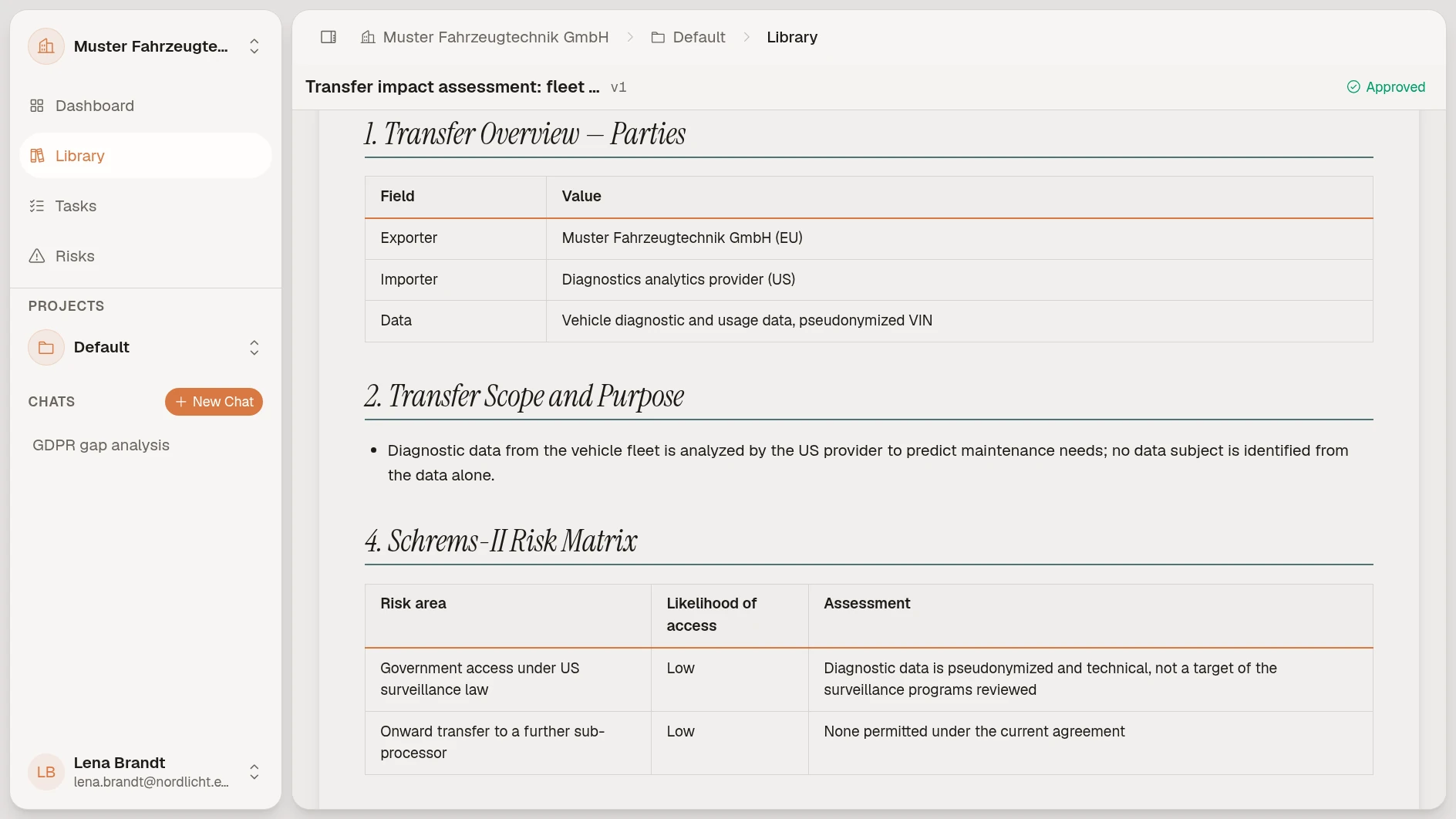
The vehicle: ISA validation and type approval.
One place for the rest of the automotive stack.
The same buyer that anonymizes camera data also answers to OEM audits, the GDPR and the EU AI Act.
- Live
GDPR records and DPIAs
Records of processing and data protection impact assessments for test fleets and connected vehicle data.
- Live
Transfer documentation
Anonymization assessment, transfer mechanism and supporting documents kept together per dataset.
- In preparation
EU AI Act
Inventory and documentation for AI systems in ADAS and driver monitoring, including those trained on your camera data.
From recording to R&D abroad in three steps.
The order matters: nothing leaves the EU before the second step is done.
- 01
Anonymize in the EU
Our anonymization model (AEON) masks faces and license plates in vehicle camera footage on EU infrastructure, before any copy leaves the EU.
- 02
Assess the dataset
Blurring alone is not the test. GPS traces, lidar, timestamps and vehicle IDs are checked against singling out, linkability and inference, dataset by dataset.
- 03
Transfer with evidence
Marsstein Compliance records what was masked, the assessment result and, where data stays personal, the Chapter V transfer mechanism and its supporting documents.
What Marsstein does, and what it does not.
Marsstein does mask faces and license plates in vehicle camera data with the anonymization model inside the EU, and record the per-dataset anonymity assessment and the transfer documentation in Marsstein Compliance.
Marsstein does not decide on its own that a dataset is anonymous, certify it, or replace legal advice. Your counsel or data protection officer signs off the assessment.
The anonymization model has processed 100+ TB of camera data.
How the anonymization model masks
Blurred is not the same as anonymous.
Anonymous data is outside the GDPR (Recital 26), and therefore outside the Chapter V rules on transfers to third countries such as China. That makes anonymizing before transfer the cleanest path, when it works.
It works only if the result is actually anonymous. Masking faces and license plates covers the obvious identifiers, but a GPS track, a precise timestamp or a vehicle ID can still point to one person. The Article 29 Working Party (Opinion 05/2014) sets three tests: can a person be singled out, can records be linked to them, can something about them be inferred.
The EDPB guidelines on connected vehicles (01/2020) point the same way: process data locally where possible, and consider anonymizing it before it is transmitted outside the vehicle.
Where data stays personal, Chapter V applies in full. China has no EU adequacy decision, so transfers need safeguards such as standard contractual clauses under Article 46. Regulators enforce this: in May 2025 the Irish DPC fined TikTok EUR 530 million in total, of which EUR 485 million for infringing Article 46(1) GDPR in its transfers of EEA user data to China.
The full flow, and the clausesPrimary sources
Every legal statement on this page rests on one of these documents.
GDPR Recital 26
Anonymous data is outside the GDPR.
GDPR Chapter V, Articles 44-49
Rules for transfers of personal data to third countries.
Article 29 Working Party, Opinion 05/2014
Singling out, linkability and inference as the tests for anonymization.
EDPB Guidelines 01/2020 on connected vehicles
Local processing; anonymization before data is transmitted outside the vehicle.
CJEU C-413/23 P, EDPS v SRB (4 September 2025)
Pseudonymized data from the recipient's perspective.
European Commission, adequacy decisions
Countries with an EU adequacy decision; China is not among them.
Irish DPC, TikTok decision (2 May 2025)
EUR 485 million for Article 46(1) GDPR transfers to China.
CAC, Several Provisions on Automotive Data Security (2021)
Exterior video with faces and plates listed as important data.
CAC, Provisions on Promoting and Regulating Cross-Border Data Flows (2024)
Articles 3 and 4: exemptions for data export.