


Marsstein EIRAService
ISA validation without the ride-alongs.
ISA validation under Delegated Regulation (EU) 2021/1958, with legal speed limits from two independent sources.
The loop in one sentence
We record a drive, establish the legal limit from two sources that never include the vehicle under test, grade the vehicle against it, and hand a person a short ranked queue with the evidence already attached.
Today and with Marsstein EIRA
From ride-alongs to ranked evidence.
The manual loop today
Ride-alongs and weeks of desk review
- An engineer rides along and manually flags events with DewesoftX
- Every flagged frame must be re-watched at a desk, one frame at a time
- Verdicts rely on subjective individual judgment and lack reproducibility
- Ground truth requires expensive map subscriptions or is missing entirely
With Marsstein EIRA
Three independent sources, recorded on board
- Three independent data legs recorded together, on-board, in real time
- Thousands of raw samples grouped into a few dozen ranked situations
- Every decision carries its written reasoning and evidence clips masked by the Marsstein AEON engine
- Runs offline from an OpenStreetMap extract: no subscription, no network, no data leaving the car
Fusion engine
Three sources, one legal limit
Leg 1 reads posted road signs, Leg 2 resolves GPS against an offline map, Leg 3 reads the vehicle's cluster display. Legal truth is established from two independent sources that never include the vehicle under test.
Leg 1
1 · Posted sign (front camera)
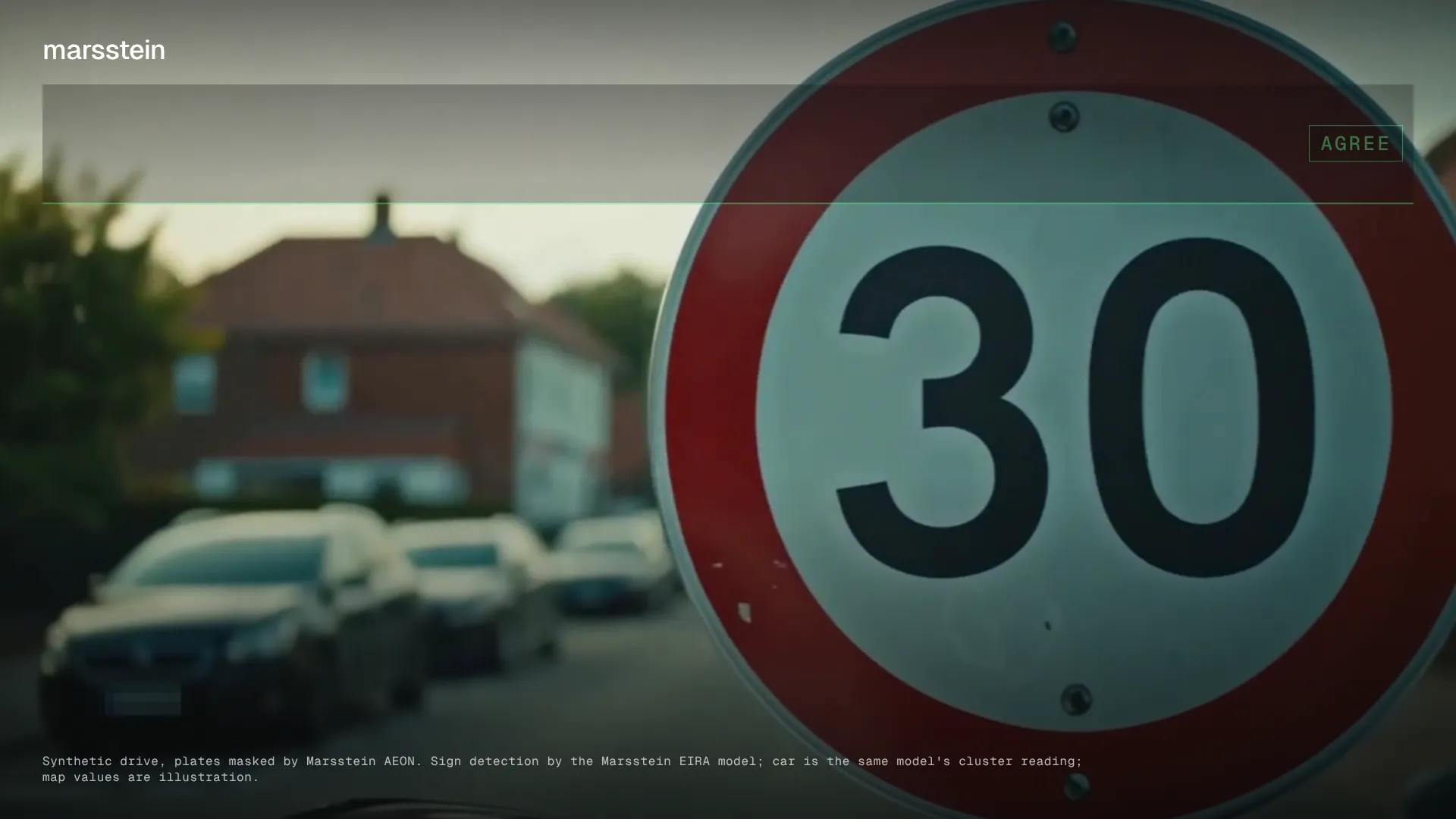
Detector and classifier with temporal voting across frames. Automatically rejects false positives on trucks or stickers.
Leg 2
2 · Offline map (OpenStreetMap extract)
Local OpenStreetMap extract on disk. No cloud, no network requests, no subscription fees.
Leg 3
3 · Instrument cluster (dash camera)
Second vision model reads the vehicle's own instrument cluster, ensuring the vehicle is graded against independent truth.
Front camera · GPS location · Cluster camera
Sign ReaderOffline MapDash ClusterTruth fusion
ISA conformity evaluation
EU 2021/1958 gates
Ranked review queue
Five situations
How EIRA decides the legal limit
The car's own ISA is never an input: it is what is being tested. The legal limit comes from the posted sign or the map, and the car is graded against it. Where neither a sign nor the map settles the limit, EIRA leaves that stretch out and reports it as lost coverage, instead of guessing.

All agree
Sign, map and car show the same limit. Pass, nothing for a human to check.

Car wrong
A confirmed, plausible sign is the legal limit. The car shows something else, so it is flagged.

Sign still holds
A sign holds after it has passed, for a distance set by the road class: 2 km on a residential street.

Map decides
No sign in range. Outside town, the country's default limit for the road applies, and the car matches it.

Map wins
The posted sign and the map agree. The car shows something else, so it is flagged.
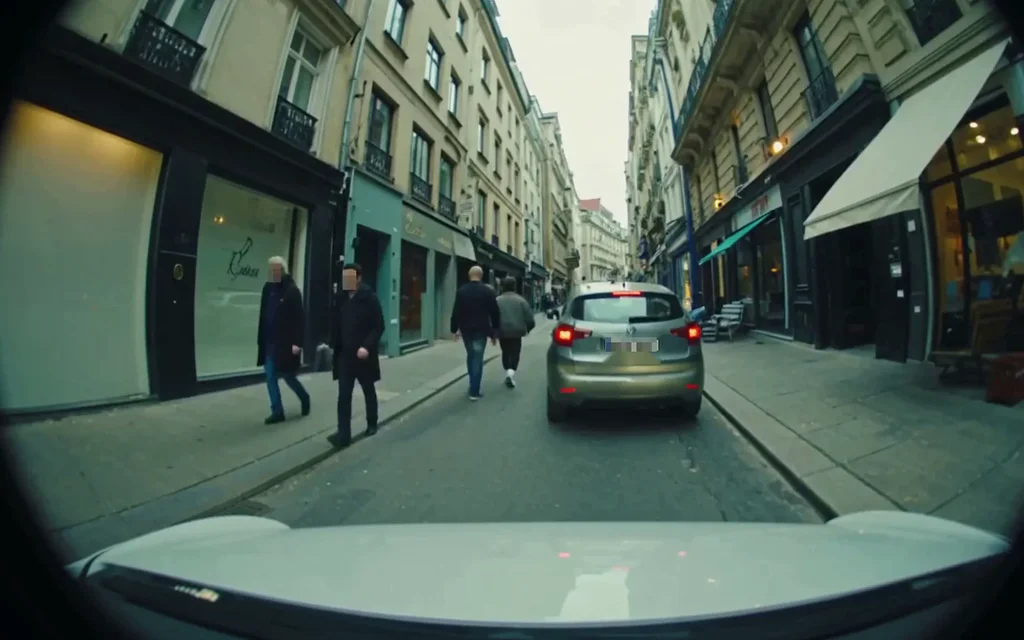
Synthetic drive, plates masked by Marsstein AEON. Sign detection is the Marsstein EIRA model's own output; car and map values are illustration where the tile says so.
Regulatory gates
Delegated Regulation (EU) 2021/1958 criteria, enforced in code
Enforced as hard software gates: if a drive misses a single criterion, it is reported as FAIL with explicit reasons.
Accuracy over distance
Accuracy weighted by distance over the whole route
Road types separately
Urban, non-urban and motorway measured separately
Road type share
A minimum share of the route enforced for each road type
Detection latency
A maximum response time after passing a sign
Route length
A minimum length for the pooled campaign route
Darkness share
A minimum share of night and darkness driving, from the sun's position
Review effort
Less review work through a ranked queue
From thousands of raw samples down to a short list for human review, ranked worst first, with masked video clips and machine recommendations attached.
With Marsstein AEON
Validated, then masked
EIRA grades the drive while it is recorded. Once the recording is saved, the Marsstein AEON engine masks faces and license plates in it. The raw recording stays internal, the masked copy is what goes to review and delivery, and the verdict overlay stays readable.
Frequently asked questions
Your question is not listed? Ask us directly.
Talk to usWhat hardware is required in the vehicle for Marsstein EIRA?
EIRA runs locally on a standard laptop with a GPU. The models for the three sources and the map engine run in parallel inside the test car.
Is video or GPS data sent to any cloud server?
No. EIRA processes all recordings offline. The OpenStreetMap extract is stored locally and no data is transmitted over cellular networks.
How does anonymization work in the loop?
After the drive, the Marsstein AEON engine masks faces and license plates in the saved recording. Capture on board stays fast, the raw recording stays internal, and the evidence you receive is the masked copy.
How does EIRA prepare reports for Technical Services?
EIRA produces reports detailing each regulatory criterion it checks, error metrics per speed class, and playable evidence clips for every conflict.